ARMored CoreSight: Binary-only Fuzzing for ARM
High-performance fuzzing framework for ARM binaries using hardware tracing features, developed during MITOU Project and productized at Ricerca Security

High-performance fuzzing framework for ARM binaries using hardware tracing features, developed during MITOU Project and productized at Ricerca Security
Published in ISSTA Companion 2025 - 34th ACM SIGSOFT International Symposium on Software Testing and Analysis
In recent years, fuzzing has gained attention as a primary means for the early detection of vulnerabilities. Although coverage-based greybox fuzzing utilizes internal coverage information to achieve high exploration efficiency, it remains difficult to employ the fuzzing framework in some restricted environments where we cannot instrument the program, such as firmware or smartphone applications. In contrast, blackbox fuzzing does not require runtime information and is thus more widely applicable, but suffers from lower efficiency because coverage cannot be measured. To address this issue, there is a growing demand for methods that can approximate coverage in blackbox environments to optimize fuzzing. One existing study proposes estimating coverage based on the relationship between program responses and strings embedded in its binary. However, this approach faces challenges with ambiguous matching algorithms and the non-uniqueness that occurs when a single string is shared by multiple basic blocks, leading to frequent misestimations. In this research, we propose a new coverage inference method, Shepherd, which combines high-precision string matching with context analysis to resolve these problems. Experimental results show that Shepherd significantly improves estimation accuracy compared to the existing approach.
Published in ICML 2026
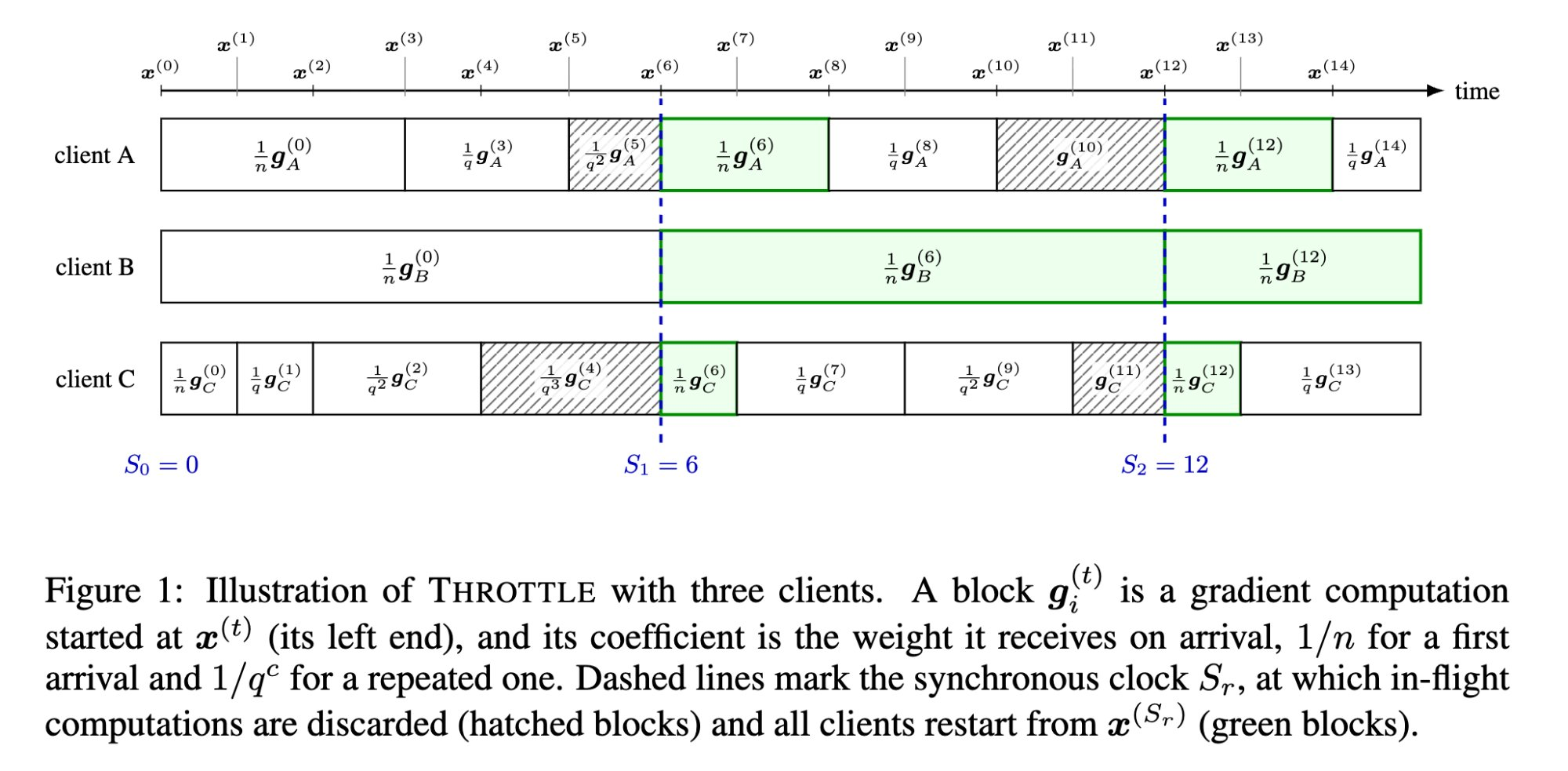
Every client gets a vote in every round, sampled or not, so Byzantine clients stay a minority. (\(\mathcal{P}\) is hiding a small trick of its own.)
Recommended citation: Kaoru Otsuka, Yuki Takezawa, and Makoto Yamada. ICML 2026, PMLR 306:95020–95050.
Link to the paper
arXiv:2609.39357; submitted to ICLR 2027 (under review), 2026
The figure below is the whole algorithm in one picture. Can you see what \(q\) does to the fast clients?
Recommended citation: Kaoru Otsuka*, Maxime Meyer*, Yuki Takezawa, Makoto Yamada, and Anastasia Koloskova. * Equal contribution.
Link to the paper
Published:
Presented at CODE BLUE 2017, one of Japan’s premier security conferences.
Security Training Camp, IPA Security Camp, 2019
Served as a Teaching Assistant at the prestigious IPA Security Camp, a government-sponsored intensive cybersecurity training program for talented young students in Japan.